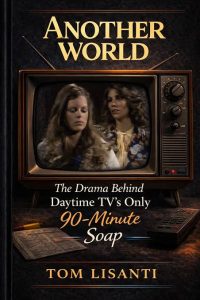
A review: “Another World: The Drama Behind TV’s Only 90 Minute Soap” by Tom Lisanti, published by BearManor Media
________________________________________________
I grew up on “Another World.” As a teenager I became addicted to daytime soaps because I found the Alice-Steve-Rachel love triangle to so appealing. Alice, a nurse (played by the late Jacqueline Courtney) was all blonde innocence and tears. Rachel (played by the unforgettable Robin Stasser) was a bitch from the wrong side of tracks who seduced her sister-in law Alice’s boyfriend, square jawed young industrialist Steve Frame played (the late George Reinholt) just when they were about to be engaged. I couldn’t wait to come home from school to see what they would do next. They were young, and exquisitely tortured on a daily basis.
But then I got older and along with “Another World” became a lot more sophisticated. Rachel was now played by Victoria Wyndham and a new production regime was in charge at “AW.” Executive producer Paul Rauch (a former CBS Daytime honcho, fine art connoisseur and huge fan of the Broadway theater) took over along with a headwriter named Harding “Pete” Lemay, who was new to daytime drama. Lemay, it was said, had grown up poor, which helped explain his particular interest in rich characters like the spoiled Steve. Rauch ushered in some big changes. He butted heads with Reinholt and fired him at the height of Reinholt’s popularity. The new team steered Rachel to meet and marry megarich leading man Mac Cory (played Shakespearean actor Douglas Watson.) Along with Mac came his ultra spoiled ultra bitchy daughter Iris (Beverlee McKinsey.) Soon there more new sophisticates in Bay City, including including architect Gwen Parrish (Dorothy Lyman) and magazine editor Cecile DePoulignac (Susan Keith.)
And so, with the ascent of the ambitious duo of Rauch and Lemay, “AW” became a soap full of intelligence and class. (It anticipated the arrival of PBS’ Masterpiece Theater a few years later.) This relatively short and interesting time (1977-82) is the period Tom Lisanti writes about in his new book, ”Another World The Drama Behind TV’s Only 90 Minute Soap.” Rauch and Lemay also launched two spinoffs: first “Lovers and Friends” and later “For Richer, For Poorer.” Neither of these shows lasted more than a year. Rauch and Lemay turned their attention back to “AW,” making it the first and only 90-minute soap, an experiment that ultimately failed.
Lisanti, an award-winning film historian whose specialty is 1960s and 1970s film and television, dives into the story with the same passion for research and discovery of the richness of pop culture history that distinguishes all his books (including two about soaps, “Ryan’s Hope” and “Texas.”)
Putting on a 90 minute soap every day was a staggering task. There was stiff competition in the afternoon time slots from other hugely successful soaps. In the late Seventies, ABC Daytime’s shows such as “All My Children” and” One Life to Live” scored high ratings due to close network supervision and sensational promotions campaigns. (Remember “Love in the Afternoon”?) The elongated “AW” just couldn’t hold its own in a time slot competing for part of the time with “General Hospital,” the show that literally struck gold with the pairing of Tony Geary and Genie Francis. Luke and Laura literally seduced a nation of mostly young viewers as piloted by its producer Gloria Monty. “AW” was forced to revert to its 60-minute form. It would stay that way until it got cancelled in 1999.
Likewise in Lisanti’s new book, the two “AW” spinoffs, largely forgotten today, receive the same meticulous treatment in evoking this era of soap history. He zeroes in on what all soaps are (still) all about—profits—by coming out and saying that Rauch and Lemay were in it for the money they could make as creators. How’s that for blatant truthtelling? Rauch and Lemay are deceased now and instead Lisanti interviewed many of the actors and backstage personnel of the period — Richard Bekins, Janice Lynde, Vicky Dawson, Eric Conger, Laura Malone and many more. Some of those stories are pretty amazing. But Lisanti does get down to more serious talk with other insiders, most interestingly Barnet Kellman, a sophisticated Broadway director brought onto the show by Rauch.
As Lisanti’s interviewees report, Rauch, as complicated as he was successful, wasn’t always the most popular general with his troops. As a young reporter, I was granted audiences with Rauch, who was disliked by many because of his brash personality. I’d like to share my own experiences with you and add some glimpses of the behavior behind the camera of this ambitious producer, whose work for the camera enriched our soap opera history so greatly.
Please check out our Substack for two columns from our archive: “He’s Back: Paul Rauch for Real” from 2008, when he took over “The Young and the Restless,” and an obituary, “Paul Rauch R.I.P.” from 2012. Find us on Substack at conniepassalacquahayman.substack.com.
And if soap opera history is a passion, as it is mine, look for Tom Lisanti’s latest, “Another World: The Drama Behind TV’s Only 90 Minute Soap,” wherever books are sold. Like all his books, it belongs in every pop culture collection.

I finished the book recently and loved every minute of it, having started watching Another World at the time Texas was spun off. At that time it was hardly at it’s best (I thought it improved around 1983, then got good again with the whole Victoria / Marley story), but it was still definitely endearing and full of great performances. The book reveals new insights into larger-than-life soap creatives Harding LeMay and Paul Rauch and the differing perspectives of many of the actors is so intriguing. And your honest and refreshing insights were great additions too, Marlena, as you were there not only as a thinking fan, but a professional with behind-the-scenes access and your own honest perspectives. One thing the book reminded me of was just how much the show relied on the very appealing Laura Malone at that time to drive story, yet the writers tortured Blaine continually in the stories they gave her, it must have been psychologically challenging to play all of those stories, it was bad enough just watching them!
Thanks so much Trent. There is so much in Tom’s really great book to savor. I was very lucky to be starting off my soap journalism career during the years the book examines. We did tons on it in Afternoon TV, which I was editor of. We went to the Brooklyn studio fairly often and got to know some of the players like Laura Malone (a great gal) and Ray Liotta who I fell in love with when he came up to our office for an interview. After that I always called him “Sweet Ray.” Plus I got to see Douglas Watson win his first Best Actor Emmy in 1981, the first Daytime Emmys I ever worked for. And years later I got to interview Vicky Wydnham and Beveralee McKinseee. I am one lucky soap journa;ist.
I had the opportunity to interview Geoffrey Sherman, who was a director on ANOTHER WORLD from around 1980-1984. He later became the director of the Shakespeare company near me, thus my proximity to Mr. Sherman. He was everything one would expect from a British Shakespearean actor-director: VERY well-spoken and articulate. The only negative things he’d say about ANOTHER WORLD were that they sometimes felt isolated in Brooklyn at the NBC Studios, away from the “New York” many know; and that he HATED directing weddings because they would start at 5:00am and end around midnight (or later, during the 90-minute era).
How interesting Michael! Thanks for contributing this old friend.
Can I ask your opinion Marlena, why do you think Beverlee McKinsey and Victoria Wyndham never won an Emmy, despite being nominated numerous times each, while Douglass Watson won twice? Was it because perhaps there was tougher competition in the female category, did they split the vote, or was it that Douglass Watson was perhaps more popular amongst his peers? Also, when are we going to be able to read YOUR book, I am sure with your career, you have several sensational books in you!
Well aren’t you nice? Thank you. I do plan to do a book on my adventures in the soap world. It’s a big mystery to me why neither Vicky nor Beverlee won an Emmy. I was so fortunate to interview both–the one I did with Beverlee was just before she passed away and I reprinted here on the website. Put her name into my search box.