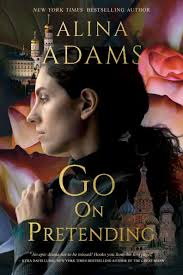
 Marlena says: I’m pleased to welcome a new guest contributor, my friend and colleague Alina Adams. To soap fans she needs no introduction. She’s written for and about soaps for more than 20 years, always exploring innovative ways to give soaps new life. An interest in historical fiction inspired two New York Times best-sellers, “The Nesting Dolls” and “My Mother’s Secret: A Novel of the Jewish Autonomous Region.” Born in the former Soviet Union, she came to America with her parents at age seven and learned English by watching soap operas. These two worlds, soaps and her Russian Jewish heritage, intersect in her new novel “Go On Pretending,” debuting May 1. In this preview, she shares an excerpt and introduces her new story, which features the great soap opera pioneer Irna Phillips.
_______________________________________________
‘Go On Pretending’: A Historical Fiction Novel About Early Days of Soaps
By Alina Adams
Historical fiction novels are usually set during times of war, revolution, upheaval and societal change.
I set mine during the early days of soap operas. Because we soap fans know daytime drama provides all those things – and more.
My May 1, 2025 book, “Go On Pretending,” begins in the 1950s, as my heroine, Rose Janowitz, faces the prospect of a job interview with Irna Phillips:
The Procter & Gamble company may have operated a plant on the northwestern corner of Staten Island so massive that locals dubbed it Port Ivory – after the institution’s best known product, but their corporate offices, including their advertising division, Compton, were located in midtown Manhattan. Rose could hardly believe that, after she’d ridden the elevator to the 11th floor and given her name, the girl sitting at the front, simultaneously answering two telephones, typing, and vetting guests, didn’t so much as blink when Rose said she was there to meet with Irna Phillips.
The Irna Phillips. The woman who had single-handedly invented radio soap operas (their nickname coming from the same product which inspired Port Ivory), and was currently the head writer of “The Road of Life,” “Young Dr. Malone,” “The Brighter Day,” “Today’s Children,” “Joyce Jordan, MD,” “The Right To Happiness,” “ Masquerade,” “The Guiding Light,” and, on television, “These Are My Children.” Irna traditionally wrote and produced her shows out of Chicago. Three years earlier, after a lawsuit that began as copyright infringement then turned into non-payment of taxes, Irna moved “The Guiding Light” to CBS Radio and relocated its production to Los Angeles. But Irna was unhappy with the acting on the West Coast. She didn’t think the Hollywood types sounded authentic enough for her wholesome, midwestern characters. So “The Guiding Light” was moving again, this time to CBS Studios on East 58th Street. Irna being Irna, had managed to requisition Liederkrantz Hall, the larger of the second floor studios. Now she needed someone to supervise production while she returned to her other shows in Chicago.
Rose intended to be that someone. She’d spent money she didn’t have on an outfit that wasn’t her in order to make sure Irna saw through the artifice and recognized how perfect the authentic Rose was for the job.
After (spoiler alert!) Rose gets the job, she and Irna face an even greater challenge:
Money, of course, was also the source of some of their greatest conflicts. Not among the staff, but among those who created the shows and those who controlled them. Sponsors loved getting into the act, demanding characters use their products, orate about using their products, and marvel at the convenience and thrift of using their products. Irna was a wizard at scripting heart-clenching drama to take place amidst a variety of cleaning supplies. If a villain wasn’t being threatened to have his mouth washed out with soap (only one brand would do!), then the heroine was hurrying to get her laundry done before her husband arrived home and learned she’d been out all day, engaging in who knows what mischief. How lucky she was that this brand of detergent took half the time for twice the results!
Their bigger problems stemmed from all that they weren’t allowed to do by Standards and Practices. According to “daytime morality,” good men and women could not smoke. This infuriated Irna, who saw thousands of dollars in potential sponsorship monies wafting away like, well, smoke. It was Rose who came up with having the bad characters be the smokers, but of having the good ones constantly remark on it. “Go, and take your (brand of) cigarettes with you!” and “I knew you’d been there. I could smell your (brand of) cigarette the second I arrived!” That way, they wouldn’t be going against the censors, but the product would still be associated with the voices of heroes and heroines.
They faced the same obstacles with alcohol. Even beer and sherry were off limits. Tea or coffee were the mandated beverages of choice, no matter what the crises. (They could always select from hot or iced, in case anyone complained of feeling creatively shackled.) Inspired by prohibition, Rose suggested to Irna that she write any drinking as either religious or medicinal. When Rose submitted that having Jewish characters would make a sip on Friday a directive from God Himself – what pious censor could deny that? – she actually pried a smile out of her redoubtable boss.
Their biggest problem, however, was sex. They couldn’t show it. This was radio, not the movies. They couldn’t speak of it. This was radio, not… the Bible. (Irna had chortled at that one, too, which was the biggest compliment Rose could hope for.) On “The Romance Of Helen Trent,” one of the few radio soaps not created by Irna, where the titular heroine had been proving that “romance can begin at thirty-five” for seventeen years; while managing to remain thirty-five – they spoke of the “emotional understanding” that could only come with marriage. And not a second before. They meant sex. Everyone knew they meant sex. But no one was allowed to say it. Irna gave notice she wasn’t going to adopt that awkward turn of phrase for her own shows.
So, on “The Guiding Light,” characters begged each other to “hold me and never let me go.” They embraced. Quite a bit. They stared into each other’s eyes. Sometimes from one day to the next. And then they somehow ended up pregnant. Viewers filled in the gaps on their own.
(For new viewers surprised by “Beyond the Gates” blatant product placement for Tide, Febreze, and other products – hold Irna’s beer, children! This is old school P&G!)
So why did I opt to set my historical fiction novel in the world of soaps? The answer is simple: Because I love soaps above all other television genres.
I began my career writing “Pure Soap” for E! Entertainment, then worked for ABC Daytime on a wide variety of projects, including composing the Lauren-Marie Taylor (Stacy) introductions for the episodes which turned “Loving” into “The City.”
I spent almost a decade at Procter & Gamble Productions, where I produced the official “As the World Turns” and “Guiding Light” websites, and wrote the NYT best-selling tie-in books, “Oakdale Confidential,” “The Man From Oakdale” and “Jonathan’s Story.”
I love to watch soap operas. I love to read historical family sagas. And I love to write about both.
“Go On Pretending” doesn’t just feature Irna Phillips as a supporting character. We’ve also got cameo appearances from “All My Children,” “One Life To Live” and “Loving” creator Agnes Nixon, “GL”’s Theo Goetz (Papa Bauer), Charita Bauer (Bert), and more!
“Go On Pretending” is my love letter to the genre, and to the fans who have supported it for close to 100 years now.
I can’t wait to hear what you all think of it!

I so appreciate Alina’s love for soaps. She’s a fun social media contributor, too. I’m looking forward to her new book.
Thank you so much G.L
Thank you so much, that’s so sweet of you to say!!